
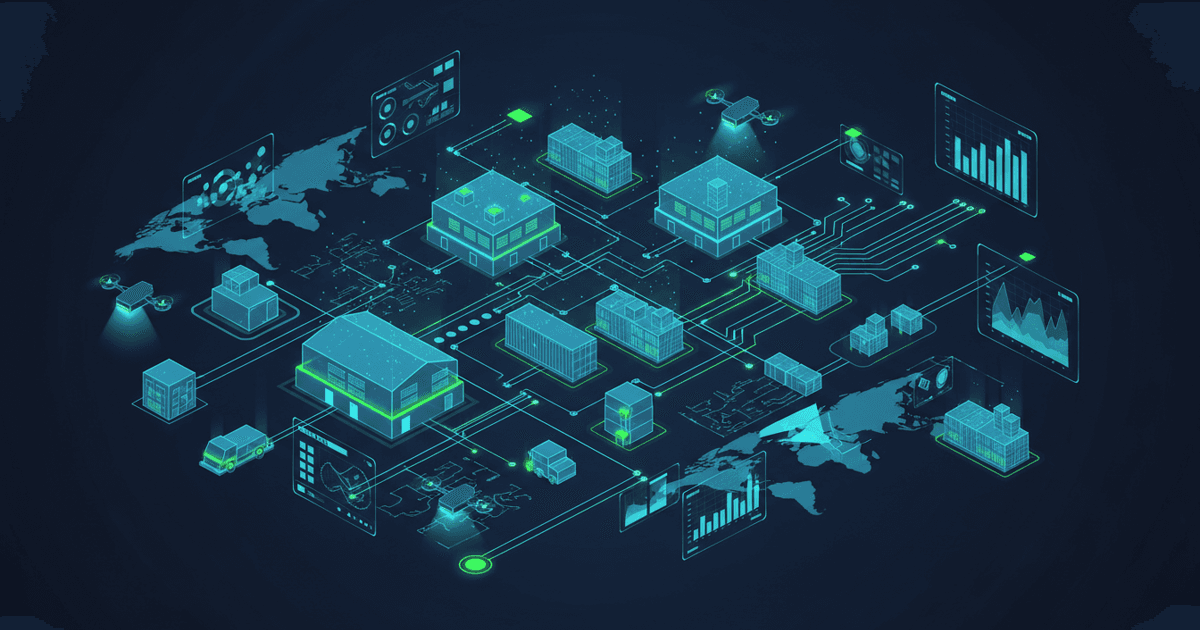
Intelligent Agents in Logistics: How AI Is Redesigning the Global Supply Chain
Technical analysis on implementing autonomous AI agents in supply chain operations, with data on operational efficiency, cost reduction, and real-world digital transformation cases in the logistics sector.
The logistics sector is facing an unprecedented technological inflection point. According to recent data from McKinsey & Company, organizations that implemented intelligent agent systems in their supply chain operations reported an average 34% reduction in operational costs and a 47% increase in order processing speed. This is no longer a futuristic scenario: it is the current reality of logistics powered by artificial intelligence.
The transition from traditional rule-based automation to ecosystems of autonomous agents represents a fundamental paradigm shift. While conventional systems execute predefined tasks, contemporary intelligent agents possess the capacity for perception, reasoning, and independent action, transforming linearly complex operations into adaptive, self-optimizing networks.
The New Landscape of AI in Supply Chain
The evolution of AI in logistics has long transcended the simple use of predictive algorithms for demand forecasting. The current generation of technologies incorporates multi-agent architectures where autonomous systems collaborate, negotiate, and execute operational decisions in real time, without direct human intervention.
From Reactive Systems to Proactive Ecosystems
The primary distinction between traditional automation and intelligent agents lies in contextual adaptation capability. Legacy systems operate through static conditionals ("if X, then Y"), while AI agents utilize reinforcement learning and natural language processing to interpret dynamic scenarios. Gartner research indicates that 65% of manufacturing organizations have already migrated part of their critical processes to autonomous agent-based platforms, with projections that this number will reach 89% by the end of 2027.
This transition is particularly evident in logistics exception management. When route deviations, supplier failures, or sudden weather changes occur, intelligent agents not only identify the problem but also orchestrate alternative solutions, recalculating routes, renegotiating deadlines with stakeholders, and adjusting inventories automatically.
Omnichannel Integration and Total Visibility
The fragmentation of sales channels demands perfect synchronization between distribution centers, carriers, and points of sale. Intelligent agents act as cognitive interfaces between legacy systems and modern platforms, eliminating information silos. Deloitte data reveals that companies utilizing logistics integration agents reduced data synchronization time between heterogeneous systems by 58%, creating a unified, real-time view of the entire value chain.
Architecture and Functionality of Autonomous Agents
Understanding the technical structure of these systems is essential for assessing their transformational potential. Intelligent agents in modern logistics operate through three fundamental pillars: environmental perception, cognitive processing, and physical or digital execution.
Real-Time Perception and Data Collection
The sensory layer of intelligent agents integrates IoT (Internet of Things), RFID, edge computing, and third-party APIs. These systems continuously process variables such as geospatial location, weather conditions, equipment status, inventory levels, and consumption patterns. Accenture documented that logistics networks equipped with perceptive agents capture 340% more operational data points compared to traditional monitoring, enabling analytical granularity previously unattainable.
Algorithmic Reasoning and Decision-Making
The cognitive core of these agents employs a combination of supervised machine learning, genetic algorithms, and, more recently, large language models (LLMs) for interpreting complex contexts. In route optimization scenarios, for example, agents simultaneously consider traffic constraints, fuel costs, delivery windows, carbon emissions, and customer preferences, calculating multi-criteria solutions in fractions of seconds.
A Capgemini study demonstrated that fleet optimization agents can process 12 million simultaneous variables to determine ideal routes, reducing total mileage by 23% and fuel consumption by 19% in last-mile delivery operations.
Autonomous Execution and Stakeholder Interaction
The action layer allows agents not only to recommend actions but to execute them directly or coordinate human and robotic resources. Advanced systems already autonomously manage warehouse replenishment, dynamic freight negotiation in digital marketplaces, and proactive communication with end customers regarding delivery changes.
Quantifiable Impact and ROI
The adoption of intelligent agents in logistics generates measurable results across multiple operational dimensions. Analysis of large-scale implementation cases reveals consistent patterns of efficiency gains and waste reduction.
| Performance Indicator | Average Improvement | Implementation Time |
|---|---|---|
| Demand Forecasting Accuracy | +42% | 4-6 months |
| Warehouse Space Utilization | +28% | 3-4 months |
| Order Cycle Time | -35% | 2-3 months |
| Picking Error Rate | -67% | 1-2 months |
| Total Transportation Cost | -18% | 6-8 months |
| Customer Satisfaction (NPS) | +31 points | 8-12 months |
Real Case: Global Distribution Network Optimization
A multinational consumer electronics manufacturer implemented an architecture of 150 interconnected intelligent agents managing 47 distribution centers across 23 countries. The autonomous agents began managing inventory reallocation between regions, component shortage forecasting, and transportation modal optimization.
Results after 18 months of operation included a 29% reduction in capital tied up in inventory, a 41% decrease in stockouts for high-rotation products, and annual savings of $127 million in logistics costs. The solution demonstrated payback in 11 months, significantly below the industry average of 24-36 months for equivalent digital transformation projects.
Sustainability and Energy Efficiency
Beyond direct economic gains, intelligent agents play a crucial role in sector decarbonization. Load and routing optimization algorithms reduce mileage traveled and fuel consumption. DHL reported that its implementation of network optimization agents resulted in a reduction of 182,000 tons of CO2 equivalent annually, representing 16% of its sustainability target for 2030.
Similar implementations across major U.S. carriers like FedEx and UPS have demonstrated comparable reductions in carbon footprint, with AI-driven route optimization contributing significantly to their respective carbon neutrality commitments. In the European Union, where the Green Deal regulations impose strict emissions standards, intelligent agents have become essential tools for compliance and operational efficiency.
Implementation Challenges and Risk Mitigation
Despite their transformational potential, the implementation of intelligent agents faces significant technical and organizational obstacles. Success depends on a structured approach that considers not only technology but also governance, cultural change, and systems integration.
Integration Complexity and Legacy Systems
Many organizations operate on fragmented IT infrastructures, with legacy ERP systems, proprietary WMS (Warehouse Management Systems), and unstructured databases. Interoperability between these environments and new AI agents requires sophisticated middleware layers and robust APIs.
The recommended strategy involves a hybrid approach: implementing agents in parallel processes (shadow mode) during a learning period, followed by gradual migration with guaranteed manual fallback. PwC studies indicate that projects using this phased deployment methodology present 74% fewer critical incidents compared to "big bang" implementations.
Algorithmic Governance and Accountability
As agents assume autonomous decisions with significant financial and operational impact, governance issues become pressing. It is necessary to establish clear frameworks of accountability, algorithmic decision auditability, and limits of automated authority.
Leading organizations are implementing "AI ethics committees" responsible for overseeing autonomous agent decisions, establishing fairness parameters in resource allocation, and ensuring regulatory compliance, especially in jurisdictions with strict legislation on data protection and automated decisions. The European Union's AI Act, for instance, requires stringent documentation and human oversight for high-risk logistics applications.
Workforce Training and Transition
Cognitive automation fundamentally alters the competency profile required in the logistics workforce. While demand for repetitive execution operators decreases, the need for data analysts, prompt engineers, and autonomous system supervisors grows exponentially.
Reskilling programs prove essential. Amazon, for example, invested $1.2 billion in training 300,000 employees to operate and supervise robotic agent systems in its fulfillment centers, demonstrating that technological transformation and human development must occur simultaneously. Similar initiatives at Walmart and Target in the United States reflect this industry-wide shift toward human-machine collaboration.
Emerging Trends and Strategic Horizon
The next cycle of evolution in intelligent agents for logistics points toward greater sophistication in multi-agent cooperation, integration with autonomous mobile robotics, and utilization of digital twins for predictive simulation.
Swarm Coordination and Collective Intelligence
Future logistics architectures will operate as swarms of specialized agents that cooperate through distributed consensus protocols. Unlike rigid command hierarchies, these systems will allow thousands of micro-specialized agents (responsible for a specific pallet, vehicle, or customer) to negotiate among themselves to optimize global objectives. MIT Media Lab research suggests that swarm architectures can increase network efficiency by up to 40% compared to traditional centralized systems.
Companies like Maersk and C.H. Robinson are already experimenting with these decentralized approaches for container logistics and freight brokerage, respectively, allowing for more resilient and adaptive supply networks.
Convergence with Blockchain and Smart Contracts
The combination of AI agents with distributed ledger infrastructure enables reliable automation of complex transactions among multiple supply chain actors. Smart contracts executed by autonomous agents guarantee automatic payments upon delivery confirmation, release of customs documentation, and compliance with quality specifications, reducing commercial friction and financial settlement time.
This convergence is particularly relevant for international trade, where documentation and payment verification often create bottlenecks. Pilots in the Port of Rotterdam and Singapore's TradeTrust initiative demonstrate how AI agents combined with blockchain can reduce document processing time from days to minutes.
Digital Twins and Advanced Simulation
The creation of complete virtual replicas of the supply chain allows agents to test hypothetical scenarios and contingency strategies without real operational risk. These simulation environments enable algorithms to learn optimal policies at accelerated speed (thousands of simulated years in hours of processing), resulting in robust strategies before physical implementation.
Siemens and GE have deployed sophisticated digital twin environments for manufacturing logistics, while Amazon utilizes similar technologies to simulate peak season operations (Prime Day, Black Friday) before committing physical resources.
Conclusion: The Imperative of Autonomous Transformation
Logistics based on intelligent agents does not represent mere technological increment but a fundamental reconfiguration of the sector's value architecture. Organizations that delay adoption of these technologies will face structural competitive disadvantage in costs, speed, and capacity to adapt to market disruptions.
The path to successful implementation requires clear strategic vision, investment in data foundations, and rigorous organizational change management. However, the documented returns—both in operational efficiency and strategic resilience—justify commitment to this transformation.
To explore how intelligent agents can specifically optimize your logistics operation and develop an implementation roadmap customized to your business needs, contact our specialists. INOVAWAY has proven expertise in autonomous systems architecture for supply chain, having implemented solutions that generated millions in operational savings for market leaders in Brazil, the United States, and Latin America.
About the Author
INOVAWAY Intelligence
INOVAWAY Intelligence is the content and research division of INOVAWAY — a Brazilian agency specialized in AI Agents for businesses. Our articles are produced and reviewed by specialists with hands-on experience in automation, LLMs, and applied AI.